Thursday, March 24, 2011

Phenylalanine

MW: 165.19
Phenylalanine (2-Amino-3-phenylpropanoic acid) has a symbol of F.7 Phenylalanine is a water-soluble amino acid that builds blocks for proteins in the body, which means the body needs it for health because it cannot make it. Phenylalanine is found in three forms: L-phenylalanine, which is the natural form found in proteins; D-phenylalanine, which is a mirror image of L-phenylalanine that is made in a laboratory, and DL-phenylalanine, a combination of both the forms.1 Phenylalanine is an essential amino acid that is nonpolar because of the hydrophobic nature of the benzyl side chain.2
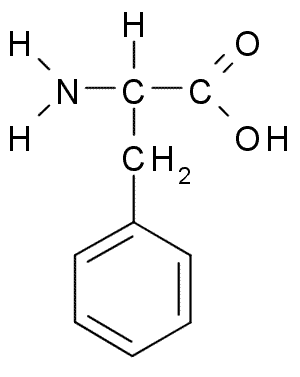

Amino group: (-NH2)
Carboxylic acid group (-COOH)
Hydrogen Group (H)


The side chain in phenylalanine composed of just carbons and hydrogens atoms.


PKA Values
The equation for pKa is: pKa = -log Ka
To find the Ka, you do this:
Ka = [H+] x [X-]/[HX]

Ka is always products over reactants.3
The Pka values of phenylalanine are 2.58 and 9.24.
Isoelectric Point
For simple amino acids, in which the R group doesn't contain any titratable groups, the isoelectric point can be calculated by averaging the pKa values for the a-carboxylic acid and a-amino groups.4
α -COOH pKa is 1.8 and  α-NH3 pKa is 9.1
1.8 + 9.1/ 2 = 5.45
Phenylalanine isoelectric point:  5.45
IR Spectrum8


Polypeptides
  
Amino acids consists of a central carbon atom chemically bonded to one hydrogen atom (H), one carboxylic acid group (-COOH), one amino (nitrogen-containing) group (-NH2), and one side group unique to each amino acid (R).9 The side group differs in shape, size, pH, and composition and gives each amino acid its identity. Peptides are amino acids linked in specific sequences to form strands of protein. One amino acid is joined to another by a peptide bond. A peptide is formed by the carboxyl group (-COOH) and bonds to an amino group (-NH2) of another amino acid and releases water in the process. A polypeptide contains more then 10 amino acids. When two amino acids join together, the carboxyl group of one amino acid is matched with another amino acid. A condensed reaction forms a peptide bond and releases water.9               

This picture shows how phenylalanine and glycine are forming a peptide bond.


Citations:

1.      University of Maryland Medical Center. Phenylalanine.


2.      Phenylalanine. Encyclopedia.

3.      Amino Acid Structure. Phenylalanine. http://www.cem.msu.edu/~cem252/sp97/ch24/ch24aa.html (accessed 2007)

4.      Amino Acid. The Acid Base Chemistry of Amino Acids. http://chemed.chem.purdue.edu/genchem/topicreview/bp/1biochem/amino2.html (accessed 2006)

5.      Amino Acid Classification for R groups. Phenylalanine. http://mcb.berkeley.edu/courses/mcb102/discussion/Handouts/Amino%20acid%20Review%20JK.pdf

6.      Identifying Amino Acids in Protein NMR Spectra. Phenylalanine. http://hoffman.cm.utexas.edu/research/aa_h_nmr.pdf

7.      X-1A x-ray Absorption Spectra. Phenylalanine. http://xray1.physics.sunysb.edu/~micros/xas/xas.html (accessed Oct. 2, 2003)

 
8.      PhotochemCAD Spectra by Category. Phenylalanine. http://omlc.ogi.edu/spectra/PhotochemCAD/html/phenylalanine.html (accessed 1998)


Sunday, March 6, 2011

electrophilic aromatic substitution:)

For this Organic blog, we are supposed to look up at least one electrophilic aromatic substitution, which is also known as (EAS) step and talk about the step in detail. After looking I found a journal titled “Regioselective Electrophilic Aromatic Substitution Reactions over Reusable Zeolites” and the authors are Keith Smith and Gamal A. El-Hiti. The article discusses how electrophilic aromatic substitution reactions are very useful in many synthetic processes, for example aromatic compounds are versatile chemical feedstocks for a wide range of industrial products, such as, pharmaceutical, agrochemicals, dyestuffs and explosives. Also talked about how nitration of aromatic compounds is one of the most important and widely studied chemical reactions. Acetyl nitrate, which is a mixture of acetic anhydride and nitric acid, was the most useful possibility. The equation looked like this:
Ac2O + HNO3             AcONO2 + AcOH           
After there compounds were nitrated there yields were excellent and with high rigoselectivity under mild conditions, using stoichiometric quantities of nitric acid and acetic anhydride, which was scheme 2 shown in the journal. Also Table 1, clearly shows how high the yields were. Overall, this article was very interesting and especially helpful with aromatic electrophilic substitution.
Resources/Citation:

Friday, February 25, 2011

A letter to grandma about aromaticity

205 Warren Place
Campbellsville, KY 42718

February 23, 2011

Mrs. Peggy Monson
112 Lane Way
Campbellsville, KY 42718

Dear Granny,

I’m going to explain the lay out of aromaticity, which is another word for fragrance. The structures of these compounds have double bonds regularly, but they don’t in fact behave like a double bond. Reagents such as bromine for example react with benzene by substitution instead of addition. Benzene and its derivatives are referred to as aromatic because of there unique odors. The aromaticity of the benzene ring can be assessed by measuring its resonance energy. A way to this is by measuring its heat of hydrogenation which is a Kekule formula. Both the heat of hydrogenation and combustion will have double bonds present, along with its bond distances being uniform, which is measured by spectroscopy. Also it will have longer wavelengths absorption bands in the ultraviolet region of the spectrum.

Huckel’s rule determines the number of π electrons that provide stability to an unsaturated planar ring. Huckel’s rule uses the formula 4n + 2. Although most polycyclic aromatic molecules follow Huckel’s rule some don’t, like pyrene, which has sixteen π electrons and is aromatic. For benzene, n = 1 and when put in the formula equals six (4n + 2 = 6), which is an aromatic sextet. The rule was calculated for single ring molecules and generally doesn’t apply to multiring systems. Also NMR can be used to measure the degree of aromaticity in a molecule by how well its ring of π electrons can maintain an induced ring current. In other words, it can be diatrophic which is were π electrons are delocalized and proteins are attached to the ring and it is shifted downfield in the nuclear magnetic resonance spectrum or NMR, where double bonds are present.

Overall, I hope I helped you understand the concept of aromaticity and I hope to see you soon.

Sincerely you’re favorite,


Alexia

Monday, February 7, 2011

Questions I was expecting to be on test!

For chapter 13 and 14 test, I expected a lot more questions from the sapling or even questions like the sapling. I studied the sapling a lot more then anything else because it basically had a question from each section in chapter 13 and 14. I know there were 5 questions, but I was expecting more then just 5 questions from the sapling. Also there were a lot of problems involving CNMR and HNMR spectrum and with that being, I was expecting there to be a problem like number 15 and 16 on the sapling, where it ask you to tell how many unique HMNR and CNMR signals exist for each compound, but instead there hardly wasn't anything about signals on the test. I also expected there to be a problem like number 17 on sapling, where it asked you to give the chemical shifts in parts per million (ppm) and it gave you the HMNR signal in Hz and the instrument in MHz. Overall, I thought the test was pretty hard and challenging and even though I was expecting a few more questions from sapling, I think I was hoping there would be to. I also think even though sapling gives you the answers and you can even hit solution to see the right answer, you still get to see how it’s done and you get a chance to look in your book for help, which you learn more by doing so.

Monday, January 24, 2011

Organic Muddiest Point

In chapter 13, my muddiest point is basically not being able to read and understand M+1 and the base peak in a mass spectrometry. I understand that the mass spectrometry is used for determining the molecular weight of a compound and identifying components of a compound. So as I explored the internet and I found the website: http://www.cbu.edu/~ddawson/212/Handouts/Mass%20Spectrometry%20Handout.pdf. This website was a handout and it helped me so much. The handout basically stated that, if the particle of interest is not positively charged, it can not be seen. This handout gave an example of the mass spectrum of toluene. In a mass spectrometry, a molecule is vaporized and ionized, usually by a bombardment with a beam of high-energy electrons; toluene has a molecular weight of 92.  Also the M+1 peak is one mass unit greater than the mass ion peak, which is 93. Finally the base peak, which is the peak with the relative intensity of 100%, is caused by the most stable cation. For toluene, the base peak is 91; the base peak is caused by the most stable cation and is also the tallest peak in the spectrum. Lastly, the handout went on to explain how to read a mass spectrum, which said to see if the M+ peak is even or odd. If it is even the molecule contains an even number of nitrogens (0 being even), like in toluene above which is 92. If the M+ peak is odd, the molecule contains an odd number of nitrogens. It also shows a comparison between the M+ and M+2 peaks. Overall, this website/handout was a great source and a lot of help because it just simply broke it down a lot better then the book did.